
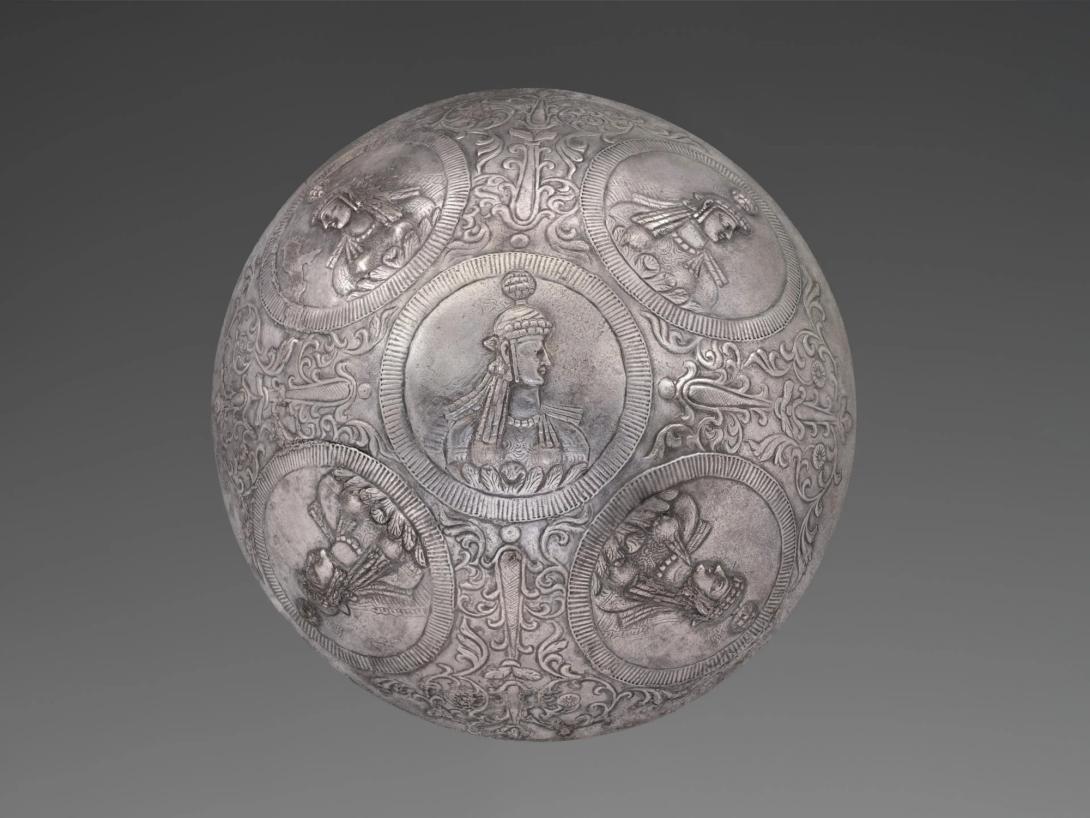
This Sasanian silver bowl, decorated with female figures, is a remarkable example of the sophisticated and distinctive metalworking tradition of the Sasanian period. It illustrates the prominent status of women during this era, particularly within the royal court and the upper social classes. Artworks such as this bowl frequently portray women in distinguished social and political roles, reflecting the respect and recognition they enjoyed in Sasanian society. The female imagery on these objects often symbolizes women's influence in the social, economic, and cultural life of the empire.
During the Sasanian period, women—especially those belonging to the royal court and the aristocracy—played significant roles beyond their familial responsibilities. They were active participants in political affairs and cultural life. Bowls such as this, depicting women in prominent settings, emphasize that women were not only held in high social esteem but also contributed to decision-making processes and cultural activities. As a result, these artistic works are regarded as enduring symbols of the power, prestige, and social influence of women in the Sasanian Empire.

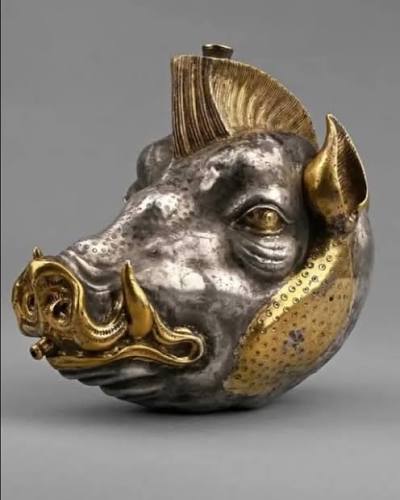
Sasanian Wild Boar Rhyton
A magnificent rhyton (drinking vessel) from the Sasanian era in Persia, crafted from a combination of gold and silver in the form of a Wild Boar Rhyton.
In Persian mythology, the Wild Boar is most closely linked to Verethraghna—a deity later known as Bahram (God of War & Victory) in Middle and New Persian. Verethraghna is the god of victory, martial prowess, and the triumph over chaos; he represents that raw energy which bursts from its lair whenever the cosmic order is threatened.
In the Avesta, Verethraghna can manifest in various forms, one of which is the male Wild Boar. This choice is no coincidence. In the Persian imagination, the Wild Boar is a tenacious, fearless, and terrifyingly unstoppable creature. Once it decides to charge, it neither calculates the path nor knows how to retreat. It embodies the very qualities expected of a victory deity: relentless pressure, the shattering of obstacles, and the breaching of barriers. As the ritual beverage pours from the Wild Boar’s mouth, power transforms into ritual, and ritual generates legitimacy.
But how was this rhyton created? The core of the object was most likely produced using the lost-wax casting method. In this process, the full form of the Wild Boar—complete with skin folds, snout, tusks, and even the expression of its gaze—was first sculpted in wax. It was then encased in a layer of refractory clay. When the mold was heated, the wax melted and drained away, leaving a hollow cavity that perfectly mirrored the original sculpture. Molten metal—usually silver—was then poured into the mold. Yet, there is a subtle nuance here: this was not merely a simple casting process. The real work began after the piece was removed from the mold. Gold details—such as the snout, tusks, mane, and parts of the face—were added using gilding or gold-overlay techniques.
During the Sasanian era, a common method was mercury gilding (amalgam gilding); gold was mixed with mercury and applied to the silver surface. Upon heating, the mercury evaporated, leaving behind a layer of gold—a hazardous yet highly precise process. Finally, the piece underwent chasing and finishing. The skin surface was textured with stippling to evoke the Wild Boar's coarse hide, eye lines and facial folds were defined using sharp steel tools, and the entire object was polished to create a stunning contrast between the cool silver and the warm gold.
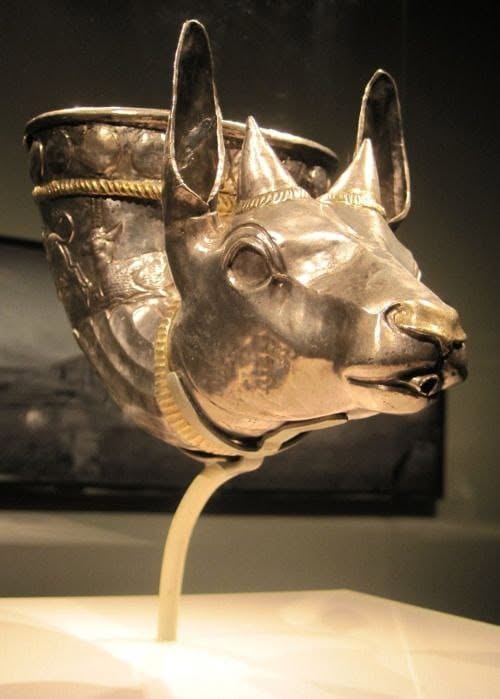 Sasanian Gazelle Rhyton |
 |
Such artifacts are more than mere metal vessels; they are symbolic expressions of the nexus between the hunt, ritual, and sovereignty. They remind us that to master the external world, civilizations must first conquer the realm of meaning. This piece was purchased from a New York gallery in the 1970s and has since been held in a private collection in London.
Page Term Reference
Comments