

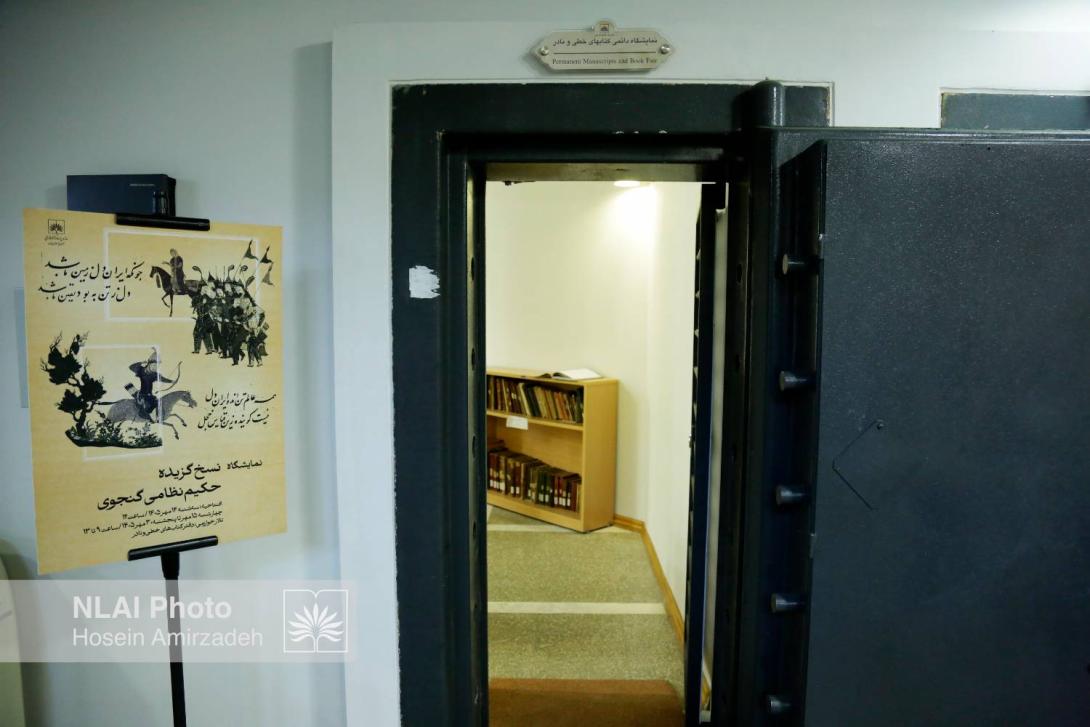

The first session of the “Narrating Manuscripts” series, focusing on “Manuscripts of Nizami’s Khamsa at the National Library,” was held with an introduction to the collection of 172 copies of the work preserved in the treasury of the National Library of Iran, alongside a comparative examination of two early manuscripts held by the National Library and the University of Cambridge.
According to the Public Relations Office of the National Archives and Library of Iran, the session was held on Tuesday, 14 Mehr 1405, from 10 a.m. to noon at the organization’s Cultural Research Center. The speakers were Somayeh Hamisheh-Bahar and Ali Miransari, with Hooman Yousefdehi serving as moderator.
At the beginning of the session, Yousefdehi welcomed the attendees and said: “We hope that this session and subsequent sessions devoted to introducing valuable manuscripts held by the National Archives and Library of Iran will receive increasing attention and have a greater impact, with the participation of distinguished scholars and the support of our colleagues.”
Somayeh Hamisheh-Bahar, a member of the Manuscripts and Rare Books Organization Department, introduced Nizami’s Khamsa and the copies held by the National Library of Iran, saying: “Nizami’s Khamsa, or the Five Treasures, is among the most distinguished and valuable works of Persian literature and comprises the five masnavis Makhzan al-Asrar, Khosrow and Shirin, Layli and Majnun, Haft Peykar, and Eskandarnameh.”
Referring to the moral, romantic, and epic themes of these poems, she added: “In stories such as Khosrow and Shirin and Haft Peykar, Nizami eloquently reveals the greatness and grandeur of Iran and the Iranian people.”
Hamisheh-Bahar continued by discussing the manuscripts of the work preserved in the National Library of Iran: “There are 172 manuscript titles of this valuable work in the library’s collection, 34 of which lack a date of transcription. Of course, not all of these manuscripts contain all five poems of the Khamsa, and only about 30 percent of them can be considered complete copies of the work.”
She added: “The diversity in the dates of transcription and the degree of completeness of the manuscripts demonstrates the extensive and enduring presence of Nizami’s Khamsa in the Persian traditions of manuscript production and copying.”
She also introduced an early manuscript entitled “Selected Khamsa of Nizami,” containing the two poems Khosrow and Shirin and Layli and Majnun, and pointed to the existence of richly decorated manuscripts with diverse artistic features in the collection. She said: “It appears that the copying of the Khamsa became more widespread and flourished during the Timurid and Safavid periods. One possible reason for this increased attention may have been the interest and patronage of the kings of these periods toward book arts and related artistic traditions. In these manuscripts, Nizami’s poetry acquired a new and enduring expression alongside calligraphy, illumination, miniature painting, and bookbinding.”
Ali Miransari, speaking later in the session, emphasized the importance of the early Khamsa manuscript held by the National Library of Iran for establishing critical editions of the poet’s works. He said: “This is not a selected manuscript; rather, it was a complete Khamsa, of which only part has survived because of missing leaves. The opening leaves of the two poems preserved in the manuscript are also missing and were recopied at a later date. The binding, too, is newer than the manuscript itself.”
Referring to another manuscript copied by the same scribe and held at the University of Cambridge, he added: “Editors of Nizami’s works should not overlook this manuscript. The main subject of my discussion is a comparison of the two Khamsa manuscripts at the National Library of Iran and the University of Cambridge, both of which were copied by Tayfur ibn Haji Kamal Yazdi.”
Miransari pointed to the broad geographical distribution of the copying and circulation of Khamsa manuscripts, stating: “Marginal notes in the manuscripts show that some of them traveled across numerous geographical regions during their lifetimes. The geography of Khamsa manuscript production is directly connected to the geography of its readership; unless there is a need and an environment for its reception, a scribe will not take up the pen.”
He also emphasized the role of the Khamsa in the expansion of the Persian language in the Indian subcontinent, saying: “Many of the manuscripts I have examined in the subcontinent had an educational function, and their marginal notes were the result of scholars’ studies or the recording of their lectures by students.”
Elsewhere in his remarks, Miransari drew attention to the potential of illustrated Khamsa manuscripts for research in the arts. He said: “Based on the examination and comparison I have carried out, no Persian literary work has provided as much ground for the creation of illustrations as the Khamsa. These illustrations offer extensive opportunities for study in terms of style, artistic school, and pigments, areas that have received relatively little attention.”
Regarding the Shiraz school, Miransari added: “The most accurate manuscripts I have seen in terms of textual readings belong to the Shiraz school. This does not mean that the Herat, Tabriz, and Isfahan schools are of lesser value; each possesses its own artistic qualities. Tayfur Yazdi, too, based on the characteristics of his works, was clearly influenced by the Shiraz school.”
Comparing the two manuscripts held by the National Library of Iran and the University of Cambridge, Miransari said: “The Cambridge manuscript contains Khosrow and Shirin and Haft Peykar, while the National Library manuscript contains Khosrow and Shirin and Layli and Majnun. Both also have missing leaves. The two manuscripts share similarities in the type of paper, the arrangement of the text in four columns, gatherings of ten leaves, the form of the colophon, and the signs used in the copying process. Elements of nasta‘liq script can also be seen in both.”
Referring to differences in the decoration of the two manuscripts, he added: “Despite evidence indicating that they were produced in the same workshop, I believe that their patrons were different. The textual readings preserved in these manuscripts also contain points that should be taken into consideration by scholars preparing critical editions.”
At the conclusion of the session, an exhibition of selected manuscripts of Nizami Ganjavi was opened at noon in the exhibition hall of the Department of Manuscripts and Rare Books, in the presence of Akbar Sabout and Gholamreza Amirkhani, head of the National Archives and Library of Iran.
The exhibition presents 13 manuscript copies of the Khamsa and selections from its constituent poems, with the aim of familiarizing visitors with the rich research potential of the organization’s manuscript collection and introducing examples of Iran’s literary heritage and book arts.
The exhibition will be open to visitors through 30 Mehr 1405, from 9 a.m. to 1 p.m.
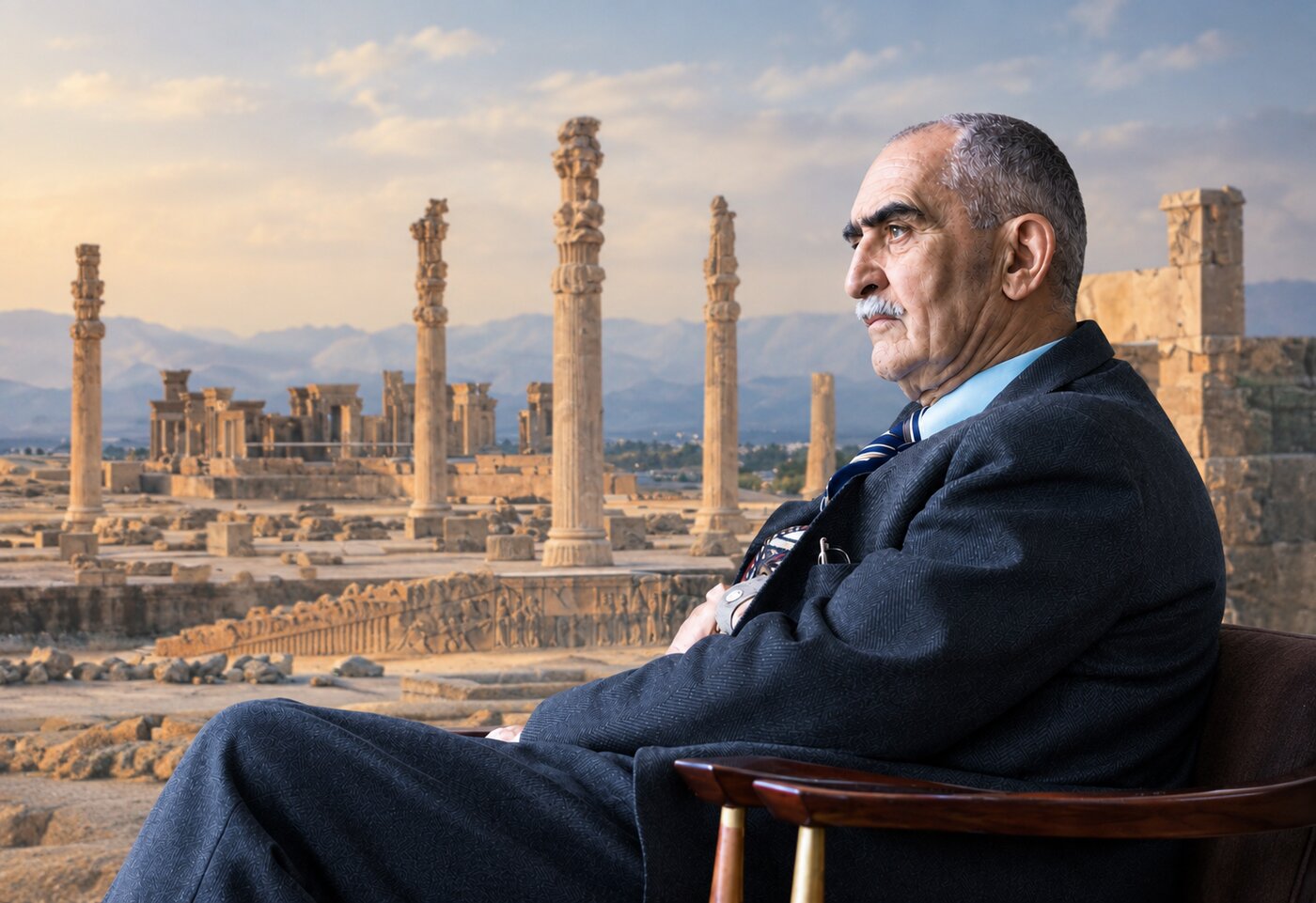
The Vigilant Guardian of the House of Iran
October 8 marks the birth anniversary of Iraj Afshar, a man who acted not merely as an eminent intellectual, but as a cultural institution in his own right. Indeed, it can be said that contemporary Iranian culture owes much of its discipline, vitality, and endurance to him.
Iraj Afshar was born on October 8, 1925 (16 Mehr 1304), into a distinguished and cultured family in Tehran. His father, Mahmoud Afshar Yazdi, was the founder of the enduring journal Ayandeh (The Future). This family environment meant that from his teenage years, Iraj grew up surrounded by books and periodicals. Although he studied law at the University of Tehran and received a bachelor's degree in judicial studies, his boundless love for Iran led him down a different path—a path along which nearly 65 years of tireless activity resulted in the authorship, editing, and compilation of more than 300 books and 3,000 valuable articles.
Afshar’s professional and administrative career is a record of firsts and lasting achievements. He was the founder and head of the Central Library and Documentation Center of the University of Tehran, and through his efforts transformed the institution into one of the country’s richest research repositories. He also served briefly as director of the National Library of Iran, and during that short period established an Iranology Center within the institution. The establishment of publications such as Farhang-e Iran-Zamin (The Culture of Iran)—in collaboration with Mamad-Taqi Danesh-Pazhuh, Sotoudeh, Mogharrabi, and Zaryab Khu’i—and his editorial work for respected journals such as Rahnamā-ye Ketāb (Book Guide) and Sokhan formed another part of his efforts to create a worthy platform for publishing the research of scholars.
But Afshar was not merely a desk-bound scholar confined to libraries. He connected historical texts and manuscripts with the realities of the land itself. He traversed Iran’s mountains, deserts, and dirt roads, photographing and documenting a mud-brick structure, an inscription, or an isolated manuscript. It was this passion for travel and recording details that produced enduring works such as Golgasht dar Vatan (Strolling in the Homeland). Through these journeys, he strengthened his cultural connection with even the most remote villages of Jiroft and the mountain foothills, as well as cities such as Borujen and Zavareh.
The great figures of Iran’s culture and literature have each viewed the magnitude of his personality from a different perspective. Dr. Mohammad-Reza Shafiei Kadkani said of him: “I can say with confidence that, in the cultural sphere, Iraj Afshar was unique. If we were to choose one person with comprehensive knowledge of our national culture and the historical geography of our contemporary era, the first would be Iraj Afshar. What a great man he was, and alas, even fifty outstanding figures could not fill the void left by that singular man.”
Ali Dehbashi, editor of Bukhara magazine, described Afshar’s humility and selfless devotion in these words: “Professor Afshar worked without expecting anything in return and solely out of love for Iran and the Persian language; it was as though it had been written into his very nature that he must work for Iran. A century must pass before another Iraj Afshar emerges.”
Dr. Mehdi Nourian, referring to Afshar’s founding of the “Congress of Iranian Research,” likewise regarded him as a steadfast pillar of scholarship. He emphasized that Afshar created the conditions for introducing prominent Iranian and foreign Iranologists and demonstrated that love for Iran acquires meaning only through a profound knowledge of its history and literature.
Ultimately, this soul devoted and passionately committed to Iran passed away on March 9, 2011 (18 Esfand 1389), following a period of illness. Yet the legacy he left behind continues to illuminate the path for scholars and researchers of Iran.
Page Term Reference
Comments